
If you are considering getting a new plan, renewing your current one or moving home, you are probably asking the same question as many people before you: “How many Mbps do I need at home?”
The right speed will depend on your needs, online activities and lifestyle. We want to make your decision easier, so let’s look at how many Mbps of fibre you need.
What is a good Internet speed?
As mentioned above, the right Internet speed depends on your needs: what you do online, how many people live in your home and how many devices are connected simultaneously.
When we talk about Internet speed, we mean megabits per second (Mbps). Think of them as the lanes through which your data travels. The more lanes you have, the faster your videos, downloads and even your favourite memes will arrive.
- Basic use, such as browsing, social media and email → 10–30Mbps.
- HD streaming and video calls → 100–300Mbps.
- Online gaming and 4K streaming → 500–600Mbps.
- Large downloads or households with many connected devices → 600Mbps–1Gbps.
A connection with at least 500Mbps download and 50Mbps upload speeds is considered suitable for most common uses.
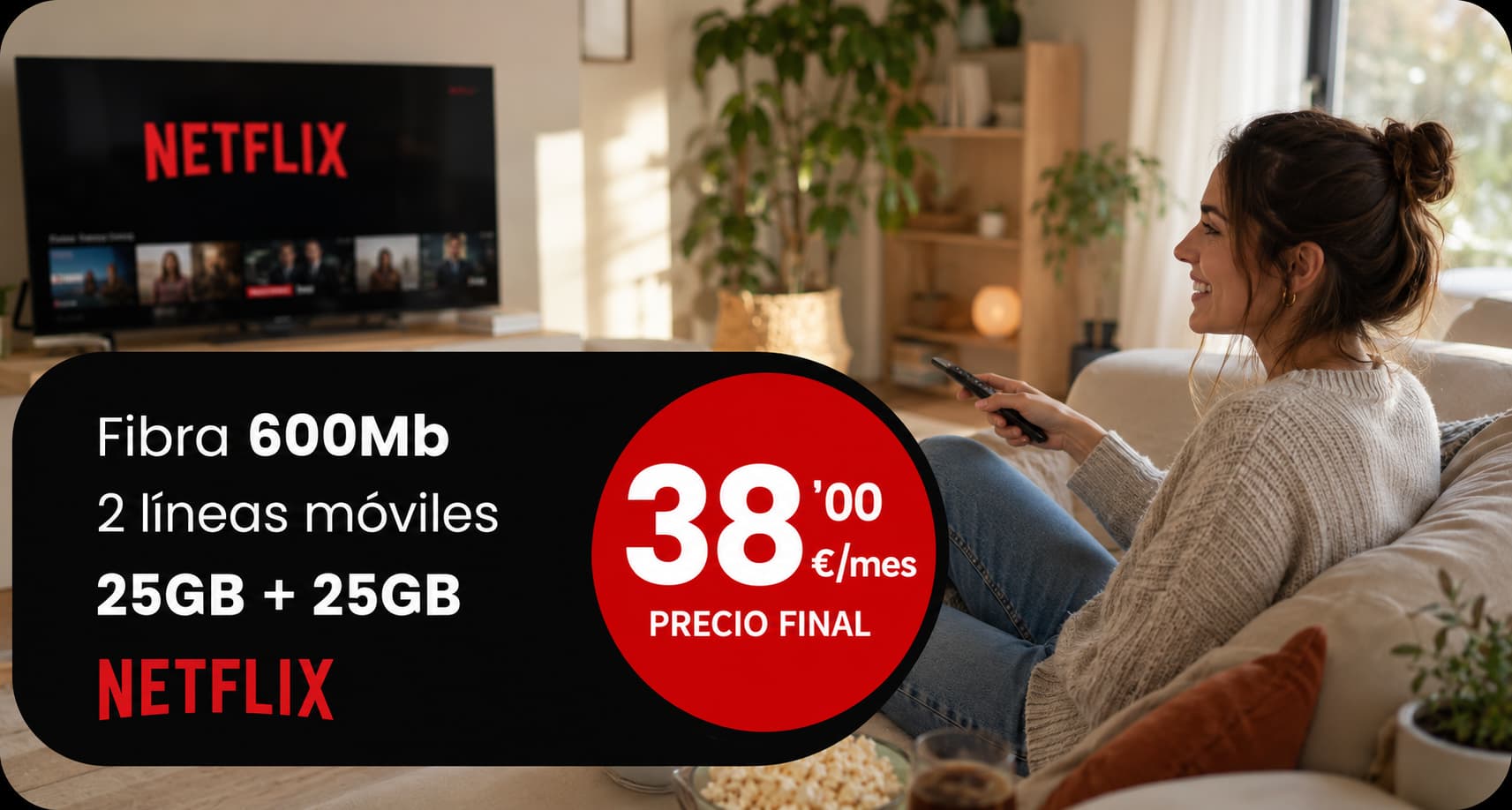
This speed allows you to enjoy platforms such as Netflix. Take a look at our fibre, mobile and TV plans to enjoy the best entertainment without interruptions.
However, this figure is only a general reference. Some people may need less bandwidth, while others may require a more powerful connection.
You should also consider upload speed, which is essential when uploading photos, participating in video calls or working with large files. Latency, although less noticeable, can make a major difference when gaming online or attending virtual meetings.
Ultimately, a good Internet speed is one that meets your needs without interruptions or frustration.
How many Mbps of Internet or fibre do I need at home?
To determine how many Mbps you need at home, we first need to understand how you use the Internet. Take a look at the list below and see which of these everyday activities apply to you.
Visit our fibre and mobile comparison tool and find out which connection best suits your needs.
How many Mbps do I need for remote working?
If you work remotely, you will need more Internet speed at home than someone who spends most of the working day away and uses the office WiFi.
It also depends on your job. Tasks such as editing documents online, sending emails and using standard office software do not require particularly high speeds. If you generally work independently, the cheapest fibre plan may be the right option for you.
However, video calls with colleagues and clients are now extremely common, and you probably do not want to be the person whose screen constantly freezes or whose audio keeps cutting out.
If this sounds familiar, you will be more comfortable with a faster connection. The same applies if your work involves uploading and downloading large files.
Are you a gamer? How many Mbps do I need for online gaming?
This is another important factor when determining how many Mbps you need. If you regularly play online games, the minimum speed we recommend is 600Mbps fibre, as it will continue to perform well when several devices are connected simultaneously.
If you also stream on Twitch or several people in your household play online at the same time, you may prefer a faster connection such as 1Gbps fibre.
How many Mbps do I need for browsing websites and social media?
Browsing websites and social media does not require a particularly powerful Internet connection. In general, a 300Mbps connection is enough to browse the Internet and view online content without any problems.
This speed offers an excellent balance between performance and cost, allowing you to stay active online and enjoy a smooth browsing experience.
Do you love series and films? How many Mbps do I need for my Smart TV?
If you spend a lot of time watching Netflix, Amazon Prime Video, HBO Max or similar platforms, you may need to have more than three devices connected at once, such as a phone, television and computer. To watch content at maximum quality, you should choose a speed above the basic level. A 600Mbps fibre connection may be sufficient.
However, if several Smart TVs will stream content in 4K or a higher resolution at the same time, consider a faster home Internet connection, such as 1Gbps fibre.
How many Mbps do I need if I share a flat?
This is naturally one of the first questions you should ask. Work out how many people live in the flat and how many devices each person uses simultaneously. The information below will help you estimate the speed you need.
How many Mbps you need based on the number of devices
In many homes and businesses, the number of devices connected to the network can significantly affect Internet speed and quality. It is therefore an important factor when deciding how many Mbps you need.
Every device requires a certain amount of bandwidth to work correctly. If many devices connect simultaneously, the network may become overloaded and slow down.
Our recommendations for how many Mbps you need at home based on the number of connected devices are shown below. However, you should also consider how those devices will be used. Having three smart speakers, one computer and one phone connected is not the same as connecting four phones, three computers, two games consoles and two televisions.
- 300Mbps: between one and four connected devices.
- 600Mbps: between four and nine connected devices.
- 1Gbps: more than nine connected devices.
So, is 300Mbps Internet fast or slow?
As with many things, the answer is relative. It depends on several factors. Read our article about whether 300Mbps fibre is enough to learn more.
Living alone with your dog in a studio flat is not the same as living with a large family in a country house or detached home.
Is 500Mbps fibre enough?
As we have seen, there is no single correct answer. A 500Mbps fibre connection is sufficient for many activities but may fall short for others.
If two people live in your household and 300Mbps is not enough, upgrading to 500Mbps may solve your connectivity problems.
This speed sits between 300Mbps and 600Mbps. However, depending on the difference in price, upgrading directly to 600Mbps may be the better choice.
What can I do with 600Mbps Internet at home?
With 600Mbps, you can have up to nine devices connected simultaneously. Sounds great, doesn’t it? It gets even better: the plan also includes a mobile line with 5G connectivity and unlimited calls.
Yes, you read that correctly. Take a look at our 600Mbps fibre and mobile plan.
600Mbps or 1Gbps: which speed should I choose?
This will depend on three factors: how you use the Internet, how many people live in your household and how many devices connect simultaneously.
We recommend 600Mbps fibre if:
- There are between two and four people in your household.
- You stream content, but not everyone does so simultaneously. Alternatively, everyone streams at the same time but not in 4K. For example, if you share one Smart TV to watch series or films together, you should not have any problems.
- You play online games, but not everyone plays simultaneously during peak hours. If two or three people play at the same time on a Friday evening, you may notice a reduction in performance.
- You work or study from home without requiring very large data transfers or downloads.
We recommend 1Gbps fibre if:
- There are more than four people in your household.
- You enjoy streaming content at the highest resolution without worrying about how many people are connected.
- Several people play online simultaneously, regardless of whether it is during peak hours.
- You work or study from home and want a consistently strong connection for large downloads and simultaneous video calls.
Regardless of whether you choose 300Mbps, 600Mbps or 1Gbps, it is important to check that you are receiving the speed included in your plan. We recommend regularly running an Internet speed test to ensure your connection meets your expectations and current needs.
Other factors to consider when choosing your home Internet speed
Although we have already considered several factors when determining how many Mbps you need at home, there are a few others to keep in mind:
- Uploading and downloading files: if you frequently upload or download large files, such as videos, images or work documents, you will need a faster connection to prevent these tasks from becoming slow or frustrating.
- Smart homes: if you have smart-home devices such as thermostats, security cameras or smart lights, you will need a reliable speed to ensure they work correctly without connection problems. These devices also increase the total number of connections on your network.
- Streaming: if you regularly stream music through services such as Amazon Music or watch live video on platforms such as Twitch, you will need a faster connection to avoid interruptions and delays.
- Video calls: if you regularly make video calls, you will need a reliable connection to prevent interruptions, pixelated images and unclear audio.
- Connection type: the speed you need may vary depending on whether you have a fibre-optic or ADSL connection. Fibre usually provides faster speeds than ADSL, although this is not the only difference between ADSL and fibre-optic Internet.
We hope this guide has helped you choose the right Internet speed. If you sign up for one Lowi speed and later decide it is too fast or too slow, you can change your fibre plan to better suit your actual needs.
If you are still undecided, find out whether 600Mbps fibre is fast enough for your home.

Como tu operador SIMPLE, Lowi se especializa en brindar soluciones simples y eficaces en telecomunicaciones. Nuestro enfoque siempre se ha centrado en la innovación de nuestros servicios de fibra y móvil, así como en ofrecer la mejor atención para todos nuestros clientes. En este Blog, redactores especializados de Lowi compartimos nuestra experiencia en el sector tecnológico y de las telecomunicaciones, para mantenerte siempre conectado y al tanto de lo mejor del sector "techie" de una forma simple.